
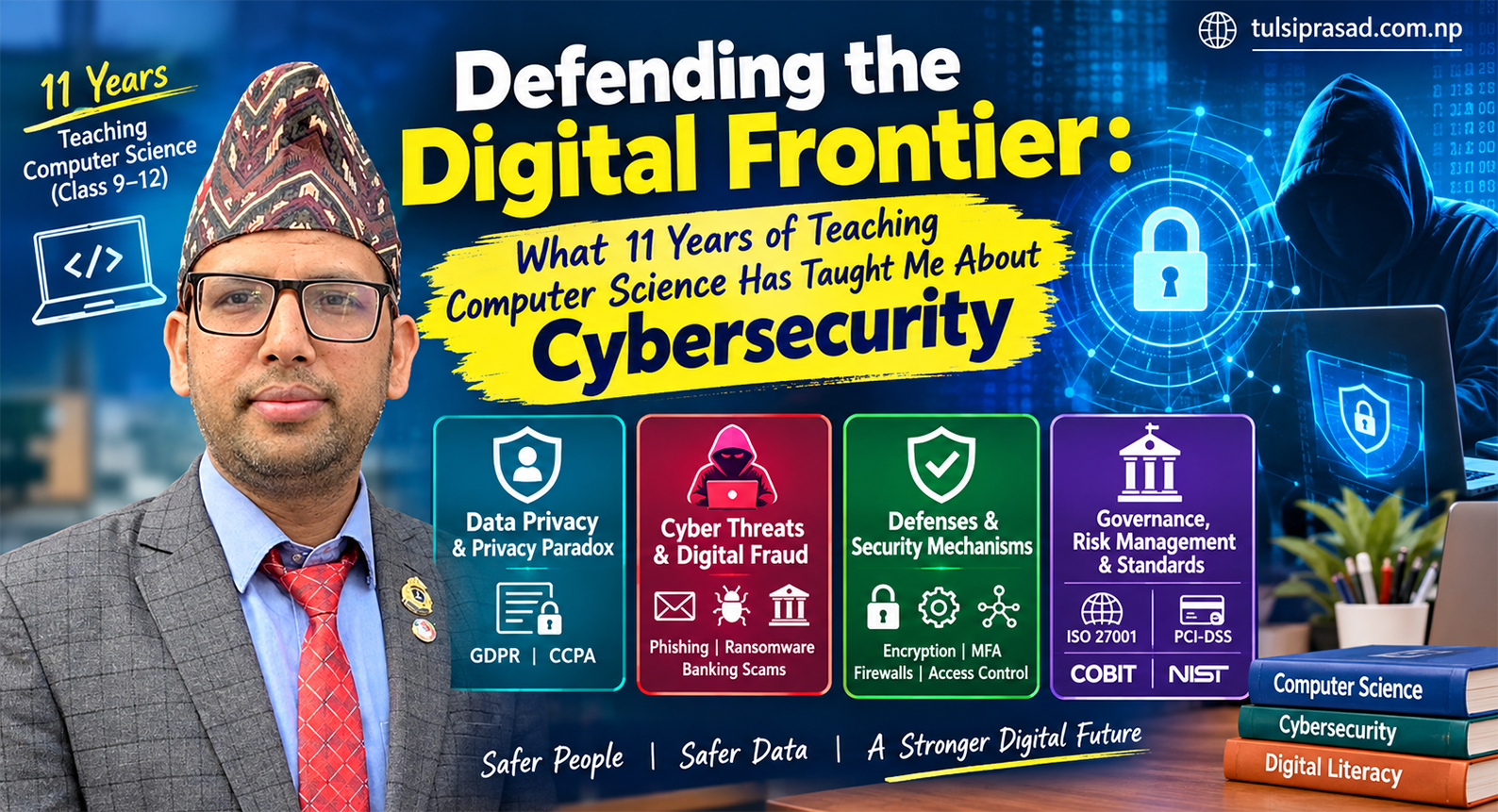
What 11 Years of Teaching Computer Science Has Taught Me About Cybersecurity
Welcome back to tulsiprasad.com.np. Over my 11 years of teaching secondary level Computer Science to Class 9 through 12 students, the digital landscape has shifted dramatically. Protecting our digital lives requires an understanding of data privacy, sophisticated threats, and strict governance frameworks. As outlined in my reference guide, “Defending the Digital Frontier: Privacy and Cybersecurity Governance”, here are the critical cybersecurity concepts I emphasize to my students.
Data Privacy and the “Privacy Paradox”
Data privacy revolves around how data is handled, specifically concerning data misuse, data breaches, and a lack of transparency. Regulations like the General Data Protection Regulation (GDPR) and the California Consumer Privacy Act (CCPA) govern these concerns. However, a fascinating concept we discuss in class is the “Privacy Paradox”—the disconnect between users’ stated privacy concerns and their actual online behavior. This paradox exists due to a lack of awareness, blind trust in companies, and complex privacy settings. Improving privacy education and developing user-friendly tools are essential solutions.
Cyber Threats, Digital Fraud, and Banking Scams
Differentiating between types of threats is fundamental. We start with malicious logic, categorizing the distinct behaviors of viruses, worms, and Trojan horses. These often open the door for intentional cyber threats like ransomware, Distributed Denial of Service (DDoS) attacks, Advanced Persistent Threats (APTs), social engineering, and phishing attacks.
Because businesses and financial institutions are primary targets, digital fraud and banking scams have become incredibly prevalent. Cybercriminals routinely impersonate bank officials through fake customer support calls or deceptive SMS links (smishing) to trick individuals into revealing One-Time Passwords (OTPs) and banking PINs. Common banking scams also include SIM swapping, where fraudsters hijack a phone number to intercept bank alerts, and fake QR code platforms designed to authorize unintended withdrawals.
Building Defenses and Security Mechanisms
Defending against these threats requires practical application. Effective cyber defense involves both general controls and application-level controls:
- General Defense Controls: These involve employee training, consistent data backups, strict access control policies, and network segmentation.
- Application Defense Controls: These focus on the software level, utilizing input validation, access management, and strict patch management.
Foundational security mechanisms include:
- Cryptography: Securing data through encryption, decryption, and hashing.
- Access Control: Implementing Role-Based Access Control (RBAC) and the principle of least privilege.
- Authentication: Moving beyond standard passwords to require Multi-Factors Authentication (MFA).
- Network Security: Utilizing digital signatures and deploying network and application firewalls.
Governance, Risk Management, and Industry Standards
For students preparing for IT careers, understanding cybersecurity governance is critical. Managing these requirements involves a continuous cycle of risk assessment, mitigation, and monitoring. Industries rely on established frameworks and standards:
- Industry Standards: Organizations must align with standards like ISO/IEC 27001 and the Payment Card Industry Data Security Standards (PCI-DSS) to securely process payments and prevent bank fraud.
- COBIT: This framework improves risk management, enhances compliance, delivers value, and provides adaptability across different industries.
- NIST Cybersecurity Framework: Built around Identify, Protect, Detect, Respond, and Recover, this framework improves incident management, enhances accountability, and aligns with best practices.
Teaching these concepts has reinforced that cybersecurity is a fundamental life skill. What specific digital fraud tactics or cybersecurity topics would you be most interested in seeing broken down in future posts?
Hi, this is a comment.
To get started with moderating, editing, and deleting comments, please visit the Comments screen in the dashboard.
Commenter avatars come from Gravatar.